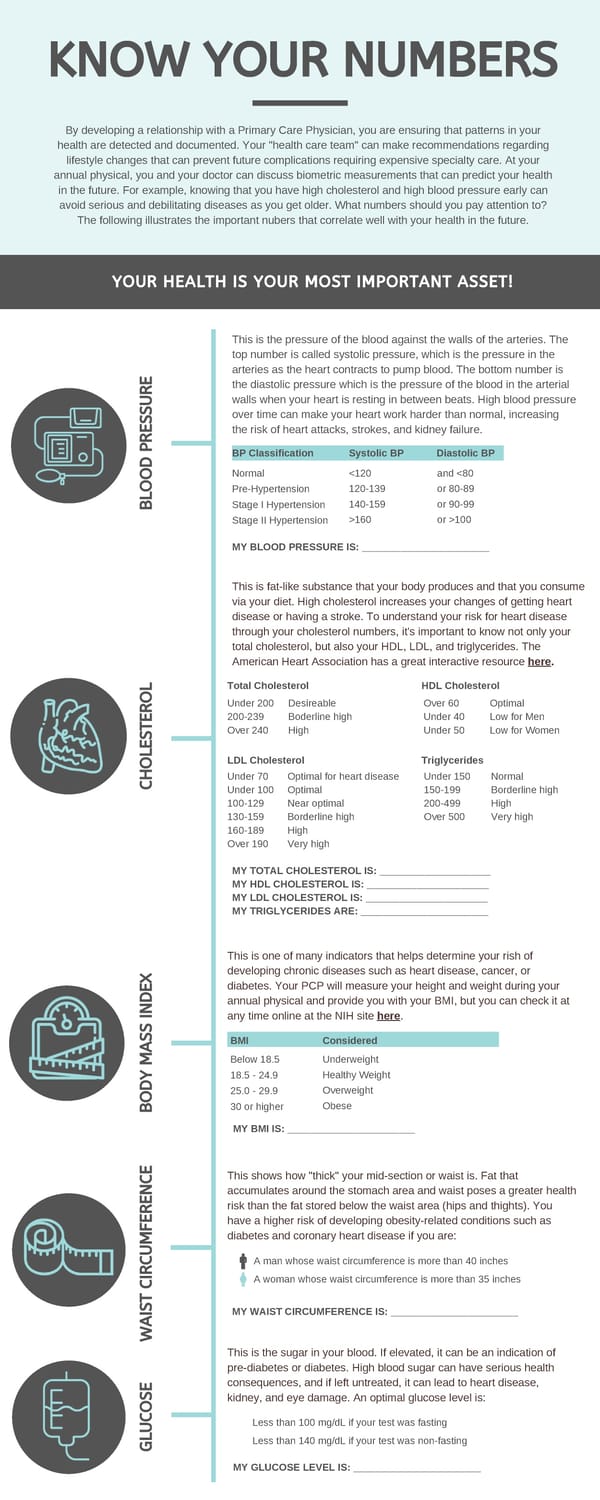
Fillable Know Your Numbers Worksheet
YOUR HEALTH IS YOUR MOST IMPORTANT ASSET! A man whose waist circumference is more than 40 inches A woman whose waist circumference is more than 35 inches BLOOD PRESSURE CHOLESTEROL KNOW YOUR NUMBERS By developing a relationship with a Primary Care Physician, you are ensuring that patterns in your health are detected and documented. Your "health care team" can make recommendations regarding lifestyle changes that can prevent future complications requiring expensive specialty care. At your annual physical, you and your doctor can discuss biometric measurements that can predict your health in the future. For example, knowing that you have high cholesterol and high blood pressure early can avoid serious and debilitating diseases as you get older. What numbers should you pay attention to? The following illustrates the important nubers that correlate well with your health in the future. This is the pressure of the blood against the walls of the arteries. The top number is called systolic pressure, which is the pressure in the arteries as the heart contracts to pump blood. The bottom number is the diastolic pressure which is the pressure of the blood in the arterial walls when your heart is resting in between beats. High blood pressure over time can make your heart work harder than normal, increasing the risk of heart attacks, strokes, and kidney failure. BP Classification Systolic BP Diastolic BP Normal Pre-Hypertension Stage I Hypertension Stage II Hypertension <120 120-139 140-159 >160 and <80 or 80-89 or 90-99 or >100 MY BLOOD PRESSURE IS: _______________________ Optimal for heart disease Optimal Near optimal Borderline high High Very high This is fat-like substance that your body produces and that you consume via your diet. High cholesterol increases your changes of getting heart disease or having a stroke. To understand your risk for heart disease through your cholesterol numbers, it's important to know not only your total cholesterol, but also your HDL, LDL, and triglycerides. The American Heart Association has a great interactive resource here . Total Cholesterol Under 200 200-239 Over 240 Desireable Boderline high High HDL Cholesterol Over 60 Under 40 Under 50 Optimal Low for Men Low for Women LDL Cholesterol Under 70 Under 100 100-129 130-159 160-189 Over 190 Triglycerides Under 150 150-199 200-499 Over 500 Normal Borderline high High Very high MY TOTAL CHOLESTEROL IS: ____________________ MY HDL CHOLESTEROL IS: ______________________ MY LDL CHOLESTEROL IS: ______________________ MY TRIGLYCERIDES ARE: _______________________ This is one of many indicators that helps determine your rish of developing chronic diseases such as heart disease, cancer, or diabetes. Your PCP will measure your height and weight during your annual physical and provide you with your BMI, but you can check it at any time online at the NIH site here . BMI Considered Below 18.5 18.5 - 24.9 25.0 - 29.9 30 or higher Underweight Healthy Weight Overweight Obese MY BMI IS: _______________________ BODY MASS INDEX This shows how "thick" your mid-section or waist is. Fat that accumulates around the stomach area and waist poses a greater health risk than the fat stored below the waist area (hips and thights). You have a higher risk of developing obesity-related conditions such as diabetes and coronary heart disease if you are: This is the sugar in your blood. If elevated, it can be an indication of pre-diabetes or diabetes. High blood sugar can have serious health consequences, and if left untreated, it can lead to heart disease, kidney, and eye damage. An optimal glucose level is: Less than 100 mg/dL if your test was fasting Less than 140 mg/dL if your test was non-fasting MY WAIST CIRCUMFERENCE IS: _______________________ MY GLUCOSE LEVEL IS: _______________________ WAIST CIRCUMFERENCE GLUCOSE